Casinos That Accept Interac UK — The Structural Reality Behind the Search Results
 Available in GB

A UK resident types "Interac casino" into Google, clicks through to a review site, scrolls past a welcome bonus banner, and hits the cashier. No Interac. Another site, same outcome. The pattern repeats until confusion sets in: half the internet promises Interac casinos for UK players, yet the actual casino cashiers tell a different story.
Here’s what those search results don’t explain upfront. Interac is a Canadian interbank network that launched in 1984 as a cooperative venture between five major Canadian banks. It moves money between Canadian accounts using Canadian clearing rails. UK banks don’t connect to those rails, and Interac holds no Financial Conduct Authority authorisation to operate payment services in the United Kingdom. The result is structural, not accidental: zero UKGC-licensed casinos accept Interac deposits from UK residents because the infrastructure to process those transactions doesn’t exist on this side of the Atlantic.
The casinos that do accept Interac sit offshore, licensed in Malta, Curaçao, or Kahnawake. They target Canadian players with native CAD accounts and Interac e-Transfer integration. A UK resident can reach those sites, but unless they hold an active Canadian bank account, the payment method remains inaccessible. The search "Interac casinos UK" generates thousands of monthly searches, most landing on affiliate content that lists Canadian-facing operators without clarifying the geographic mismatch.
This guide resolves that gap. You’ll learn why the UK Gambling Commission’s payment ecosystem excludes Interac, which offshore casinos accept it and what that means for player protections, and which UK-regulated alternatives deliver comparable speed and security at UKGC-licensed sites. No affiliate spin, no vague warnings. Just the technical and regulatory reality of Interac availability for UK players in 2026.
Table of Contents
- The Short Answer: Can UK Players Use Interac at Online Casinos?
- Why UKGC-Licensed Casinos Don’t Accept Interac
- Offshore Casinos That Accept Interac (And What UK Players Need to Know)
- What You Lose by Playing at Offshore Casinos Instead of UKGC Sites
- UK Payment Alternatives to Interac (What Actually Works at UKGC Casinos)
- Deposit and Withdrawal Mechanics (If You Have a Canadian Bank Account)
- Interac at UK Casinos: What the Search Results Don’t Tell You
- Bonuses and Promotions at Offshore Interac Casinos
The Short Answer: Can UK Players Use Interac at Online Casinos?
No, typical UK residents cannot use Interac at any casino, UKGC-licensed or offshore. The payment method requires a Canadian bank account linked to Interac’s domestic clearing network. UK banks — Barclays, NatWest, HSBC, Lloyds, Santander, and the rest — do not integrate with that network. They process domestic payments through Faster Payments, CHAPS, and Bacs clearing systems, none of which connect to Interac’s Canadian rails.
Can I use Interac at UK online casinos?
No. Interac operates exclusively within Canada’s interbank network and requires a Canadian bank account. UK banks do not connect to Interac, and the payment method lacks FCA authorisation to operate in the UK, so no UK-licensed or offshore casino can process Interac transactions from a standard UK bank account.
The technical barrier runs deeper than regulatory paperwork. Interac e-Transfer, the casino-relevant product, sends funds between Canadian financial institutions using email or mobile-number identifiers linked to account details held by participating banks. The recipient casino must hold a Canadian bank account or merchant agreement with an Interac-connected payment processor to receive those transfers. UKGC-licensed operators process GBP payments through FCA-regulated providers; none of those providers offer Interac integration because the method has no presence in the UK payment landscape.
Interac Corp itself positions the service as Canadian domestic infrastructure. Its public statements and partnership announcements focus on coverage within Canada, with limited international expansion confined to specific corridors like Interac e-Transfer to Mastercard Send for cross-border remittances via National Bank. Casino deposits fall outside that scope. A UK player attempting to initiate an Interac e-Transfer from a UK bank account would hit an error at the bank’s online-banking interface; the option simply wouldn’t appear.
The rare exception: UK residents who maintain an active Canadian bank account from prior residency. That niche can technically use Interac at Canadian-facing offshore casinos, but doing so introduces verification complications. Casinos require proof of identity matching the bank account holder, and most implement geographic checks via IP address. Using a VPN to appear Canadian while residing in the UK can trigger anti-money-laundering flags or account suspension. The edge case exists in theory; in practice it’s messy and rarely worth the friction for anyone whose primary banking is now UK-based.
Interac’s domestic focus isn’t accidental. The network evolved as a national payments utility, owned by a consortium of Canadian banks, designed to compete with international card networks by keeping transactions and clearing fees inside Canada. That strategy works for the Canadian market but makes cross-border expansion structurally unattractive. UK payment systems developed along parallel lines through LINK, Faster Payments, and Open Banking, creating a mature ecosystem with no gap for Interac to fill. The infrastructure mismatch is mutual: Canadian banks don’t offer UK payment rails, and UK banks don’t offer Interac.
So when a search result promises "Interac casinos UK," what’s actually being described? Usually Canadian-facing offshore operators that appear in UK search results because affiliates target UK search demand, not because UK players can use the method. The listing might technically be accurate — those casinos do accept Interac — but the implicit promise of availability to UK users is false.

Why UKGC-Licensed Casinos Don’t Accept Interac
UKGC operators must use payment providers authorised by the Financial Conduct Authority under the Payment Services Regulations 2017 and Electronic Money Regulations 2011. Interac Corp holds no such authorisation. Its FCA register entry doesn’t exist, and it has never applied for UK payment institution or e-money institution status. Without that regulatory gateway, no UKGC-licensed casino can legally offer Interac as a deposit or withdrawal method to UK customers.
The FCA requirement isn’t bureaucracy for its own sake. Payment service providers in the UK must meet capital adequacy requirements, segregate customer funds, implement anti-money-laundering controls, and submit to ongoing supervision. Interac operates under Canadian regulatory frameworks — primarily provincial consumer protection laws and federal Proceeds of Crime rules — but those don’t confer UK equivalency. A Canadian payment network with no UK legal entity, no UK-based operations, and no FCA registration simply doesn’t qualify under UK gambling payment regulations.
Even if Interac sought FCA authorisation, the business case wouldn’t stack up. UKGC operators serve a UK customer base with GBP-denominated accounts and demand for payment methods that UK consumers already use. Interac’s value proposition — direct bank-to-bank transfers within the Canadian interbank network — offers zero advantage in a market where Faster Payments, Open Banking via Trustly, and card networks already deliver instant GBP deposits. Integration costs and compliance overhead would buy access to a payment method that UK players neither recognise nor can use.
This dynamic sits within a broader UK payment-method tightening over recent years. The UKGC banned credit card deposits in April 2020, citing harm-reduction evidence around debt-fuelled gambling. Affordability checks intensified between 2023 and 2024, with operators required to intervene when customers show signs of financial stress. The FCA updated its safeguarding regime for payment and e-money firms in May 2026, tightening rules on how customer funds are protected before they clear. The regulatory direction is toward fewer, more closely supervised payment channels, not expanding into niche international methods with limited UK applicability.
Contrast this with how Interac works in its home market. Canadian online casinos — those licensed by provincial regulators in Ontario via the AGCO, or offshore operators licensed in Malta, Kahnawake, or Curaçao and targeting Canadian players — integrate Interac because nearly every Canadian adult banks with an institution in the Interac network. Deposits clear in minutes, withdrawals in one to three business days, and the method bypasses international card fees. It’s the default payment choice for Canadian casino players, comparable to debit-card dominance in the UK.
But transplanting that model to the UK hits the clearing-system wall. When a Canadian player initiates an Interac e-Transfer to an offshore casino, their bank sends the transaction through Interac’s domestic rails to a receiving Canadian account held by the casino or its payment processor. Settlement happens in CAD within the Canadian banking system. A UK player attempting the same thing has no entry point: UK bank accounts don’t issue Interac e-Transfers, and UK clearing systems don’t speak to Interac’s network.
The architecture is incompatible by design. Interac deliberately built a closed-loop system to keep Canadian payment volume inside Canadian infrastructure, generating revenue for member banks and avoiding reliance on Visa or Mastercard for domestic transactions. That strategic choice makes Interac valuable in Canada and irrelevant everywhere else. The UK developed its own closed-loop alternative with Faster Payments, which launched in 2008 and now underpins instant bank transfers, Open Banking, and Pay by Bank services at UKGC casinos. Both systems work brilliantly within their respective markets; neither needs the other.
So the absence of Interac at UKGC casinos isn’t a regulatory oversight or a temporary gap waiting to be filled. It’s the predictable outcome of two mature, domestically optimised payment infrastructures that were never designed to interoperate. UK players searching for Interac casinos are chasing a payment method that exists in Canada, not the UK, and no amount of affiliate content listing "Interac casinos UK" changes the underlying technical and regulatory reality.
Offshore Casinos That Accept Interac (And What UK Players Need to Know)
Three Malta and Kahnawake-licensed operators dominate the Interac casino space: Jackpot City, Spin Casino, and Ruby Fortune. All three target Canadian players, accept CAD natively, and integrate Interac e-Transfer for deposits and withdrawals. They appear in UK search results because affiliates chase UK search demand, but the Interac functionality only works for players with Canadian bank accounts. A UK resident with UK-only banking cannot deposit via Interac at these sites, regardless of licensing.
| Operator | License | Withdrawal Speed | Min Deposit | Distinguishing Feature | |—|—|—|—| | Jackpot City | MGA MGA/B2C/145/2007, Kahnawake #00902 | 2–5 business days | CAD 10 | Operating since 1998, Super Group ownership, eCOGRA certified | | Spin Casino | MGA MGA/B2C/145/2007, Kahnawake #00892, UKGC #39495 | 24 hours (claimed) | CAD 10 | Dual-brand strategy (offshore and Ontario-regulated sites), UKGC license exists but no Interac on UK site | | Ruby Fortune | MGA MGA/B2C/145/2007, Kahnawake #00892 | 1–3 business days | CAD 10 | 20+ years continuous operation, Casino Rewards loyalty program |
Is it legal for UK players to use offshore casinos that accept Interac?
Yes, UK law does not criminalise players for using offshore casinos. However, offshore operators sit outside UKGC jurisdiction, meaning UK players lose access to GAMSTOP self-exclusion, UK Alternative Dispute Resolution services, UKGC complaint processes, and safer gambling protections mandated under the Licence Conditions and Codes of Practice.
Jackpot City
Jackpot City has operated continuously since 1998 under Bayton Ltd, a Malta-registered entity holding MGA license MGA/B2C/145/2007. The Canadian-facing version also carries Kahnawake Gaming Commission license #00902 C15-0068, while the Ontario-specific site operates under an AGCO iGaming Ontario registration managed by CADTREE Limited. Parent company Super Group, publicly traded on the NYSE, owns the brand alongside a portfolio of other casino and sports-betting properties.
The game library sits around 500 titles sourced from Microgaming’s Games Global network and Evolution Gaming’s live dealer studios. Deposits via Interac e-Transfer post instantly with a CAD 10 minimum; withdrawals process in two to five business days for players outside Ontario, one to three business days for Ontario residents. The welcome bonus structure spreads CAD 1,600 across the first four deposits, though the 70x wagering requirement on bonus funds and a six-times-first-deposit maximum cashout rule make the "welcome" offer more restrictive than its headline figure suggests.
eCOGRA certification appears prominently in the site footer, signalling third-party audits of random-number-generator fairness and payout percentages. That’s reassuring for Canadian players within Jackpot City’s target market. UK residents face a different calculation: Interac deposits won’t work unless they hold a Canadian bank account, and even then, verification checks may flag a UK IP address or UK proof-of-identity documents. Customer support operates in English and French, reflecting Canadian linguistic requirements, but response times for non-Canadian queries can lag.
Spin Casino
Spin Casino launched in 2019 as a rebrand of Spin Palace, which had operated since 2001. The current brand is split across two legal entities: Bayton Ltd (MGA MGA/B2C/145/2007) for the international site at spincasino.com, and CADTREE Limited for the Ontario-regulated site at spincasino.ca. A Kahnawake license (#00892, issued February 16, 2022, via Baytree Interactive Ltd, Guernsey company #69691) covers Canadian players outside Ontario. Confusingly, Spin Casino also holds UK Gambling Commission license #39495, but the UK-facing version of the site does not offer Interac — payment methods there default to Visa, Mastercard, PayPal, and Skrill.
The dual-brand strategy means a UK player visiting spincasino.com sees one cashier (no Interac), while a Canadian player on the same domain sees Interac e-Transfer prominently listed. Geolocation determines which payment menu loads, and UK IPs are routed to the non-Interac version. That makes Spin Casino technically truthful when marketing materials say "we accept Interac," but misleading for UK audiences who find it through UK-targeted search results.
Game selection spans the Games Global catalogue with Evolution Gaming live dealer tables. Minimum deposit sits at CAD 10 via Interac on the Canadian site, and the casino claims 24-hour withdrawals, though actual clearance depends on the player’s bank and whether account verification is complete. The welcome offer reaches CAD 1,000, structured similarly to Jackpot City’s tiered approach. Super Group’s ownership again provides corporate stability, but for UK players, Spin Casino functions as just another offshore operator with no practical Interac access unless they’ve maintained Canadian banking.
Ruby Fortune
Ruby Fortune launched in 2003 and remains one of the longest-running brands in the Canadian online casino space. Operated by Baytree Interactive Limited under Kahnawake license #00892, with Malta MGA/B2C/145/2007 coverage and Ontario AGCO registration OPIG1237898 via CADTREE Limited, it targets the same Canadian demographic as Jackpot City and Spin Casino. The Casino Rewards loyalty program integrates across multiple sister sites, allowing players to accumulate points at Ruby Fortune and redeem them at other properties in the network.
The game library leans heavily on Microgaming’s back catalogue, now distributed via the Games Global umbrella, with Evolution Gaming handling live dealer. Interac e-Transfer deposits clear instantly with a CAD 10 minimum; withdrawals typically land in one to three business days once the casino approves the cashout request. The welcome bonus structure offers CAD 750 spread over multiple deposits, with terms comparable to the other operators listed here. Wagering requirements and game weightings follow standard industry patterns — slots contribute 100 percent, table games contribute far less or not at all.
Ruby Fortune’s 20-year operational history provides a form of social proof: it hasn’t disappeared overnight, and its MGA license has remained active without suspension. That longevity matters more to Canadian players weighing which offshore site to trust than to UK players who can’t fund an account via Interac anyway. The edge case remains: a UK resident with a Canadian bank account could theoretically deposit here, but verification friction and VPN detection risks make it a poor fit for anyone whose primary residence and banking are now UK-based.
Which offshore casinos accept Interac for UK players?
Offshore casinos licensed in Malta, Kahnawake, or Curaçao accept Interac for Canadian account holders. UK residents cannot use Interac at these sites unless they hold an active Canadian bank account, which creates verification and VPN complications. Jackpot City, Spin Casino, and Ruby Fortune are the main operators.
What You Lose by Playing at Offshore Casinos Instead of UKGC Sites
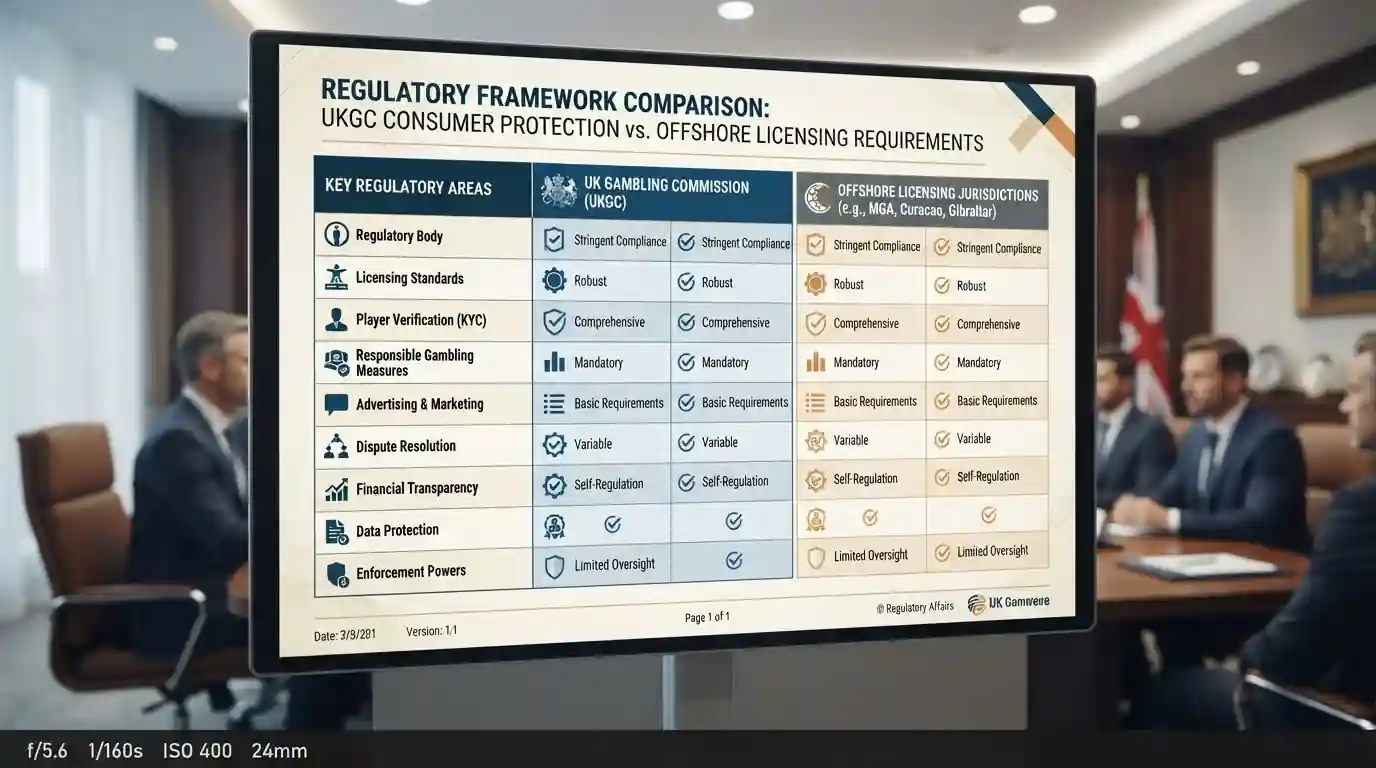
UKGC-licensed casinos operate under Licence Conditions and Codes of Practice that mandate player protections offshore operators don’t provide. The trade-off isn’t abstract. Specific safeguards disappear when a UK player moves from a UKGC site to a Malta or Curaçao-licensed alternative, and those gaps only become visible when something goes wrong.
| Protection | UKGC Casino | Offshore Casino |
|---|---|---|
| GAMSTOP self-exclusion | Mandatory participation; blocks access across all UK-licensed operators | Not connected; self-exclusion applies per-site only, no national network |
| Alternative Dispute Resolution | Free ADR service (IBAS or CEDR) required; binding decisions up to £10,000 | ADR optional, often Malta-based (eCOGRA, MADRE); UK players may face jurisdiction issues |
| Safer gambling tools | Mandatory deposit limits, time-outs, reality checks, account history access | Implementation varies; limits often set by player request rather than proactive prompts |
| Fund segregation | Player funds held in separate accounts; protected if operator becomes insolvent | Segregation required under MGA rules but enforcement and insolvency procedures differ |
| Complaint escalation | UKGC complaint process available if ADR fails; regulator can investigate and sanction | MGA or Curaçao complaint process; no UK regulator involvement; enforcement record weaker |
| Advertising standards | ASA and CAP Code rules apply; misleading claims can be reported and sanctioned | UK advertising rules don’t apply; promotional claims harder to challenge |
| Identity and age verification | Mandatory verification before first withdrawal or within 72 hours of registration | Verification often delayed until withdrawal; some operators accept play before KYC |
| Responsible gambling messaging | Mandatory safer gambling messages on site and in marketing | Present but less standardised; varies by operator |
What player protections do I lose by using an offshore casino instead of a UKGC-licensed one?
UK players at offshore casinos lose access to GAMSTOP national self-exclusion, free UK Alternative Dispute Resolution services, UKGC complaint escalation, mandatory safer gambling tools, and UK-regulated fund segregation. Disputes are handled under Maltese or Curaçao law, and enforcement is weaker than UKGC oversight.
GAMSTOP is the most visible gap. A UK resident who self-excludes via GAMSTOP cannot register at any UKGC-licensed casino for the exclusion period, typically six months, one year, or five years. The block is automatic, national, and enforced at the point of registration. Offshore casinos don’t connect to GAMSTOP. A player can self-exclude from one offshore site and immediately register at another. That fragmentation undermines the purpose of self-exclusion: creating friction between impulse and action.
The ADR difference becomes apparent when a dispute arises. UKGC operators must offer free Alternative Dispute Resolution through approved providers like IBAS (Independent Betting Adjudication Service) or CEDR. The ADR can issue binding decisions up to £10,000, and the casino must comply or risk its license. Offshore operators licensed in Malta typically offer eCOGRA or MADRE as ADR options, but those services operate under Maltese law, and their decisions aren’t binding in the same way. UK players may find their complaints taken less seriously or resolved in the casino’s favour on procedural grounds.
Fund segregation rules exist under MGA licensing, but the practical protection differs. UKGC operators hold player funds in separate client accounts at UK banks, ring-fenced from operating capital. If the operator becomes insolvent, player balances are protected. MGA-licensed operators must also segregate funds, but enforcement and insolvency procedures follow Maltese law. Curaçao-licensed operators face lighter oversight, and player-fund protection in insolvency is less reliable. The risk is low at established brands like the ones listed above, but it’s higher than at UKGC sites.
Safer gambling tools are mandatory at UKGC casinos. Operators must offer deposit limits, loss limits, time-outs, self-exclusion, and reality checks. Players must be prompted to set limits within the first session or shortly after. Offshore operators offer similar tools, but implementation is voluntary and less standardised. A player at an offshore casino might need to hunt through account settings to find the deposit-limit option, whereas a UKGC site surfaces it prominently during onboarding.
The complaint escalation path diverges sharply. If ADR doesn’t resolve a dispute at a UKGC casino, the player can escalate to the UKGC itself. The regulator can investigate, sanction the operator, and order remediation. That process has teeth. Offshore complaints escalate to the MGA or Curaçao eGaming, regulators with less hands-on enforcement. The MGA’s track record is stronger than Curaçao’s, but neither matches the UKGC’s responsiveness to UK-resident complaints.
None of this makes offshore casinos categorically unsafe. Established MGA-licensed operators like those listed above have years of operational history and reputational incentives to handle disputes fairly. But the structural protections are weaker, and the burden shifts to the player to research the operator’s track record, understand the foreign legal framework, and accept that UK consumer protections won’t apply. For UK residents chasing Interac functionality they can’t actually use, that trade-off delivers no benefit.
UK Payment Alternatives to Interac (What Actually Works at UKGC Casinos)
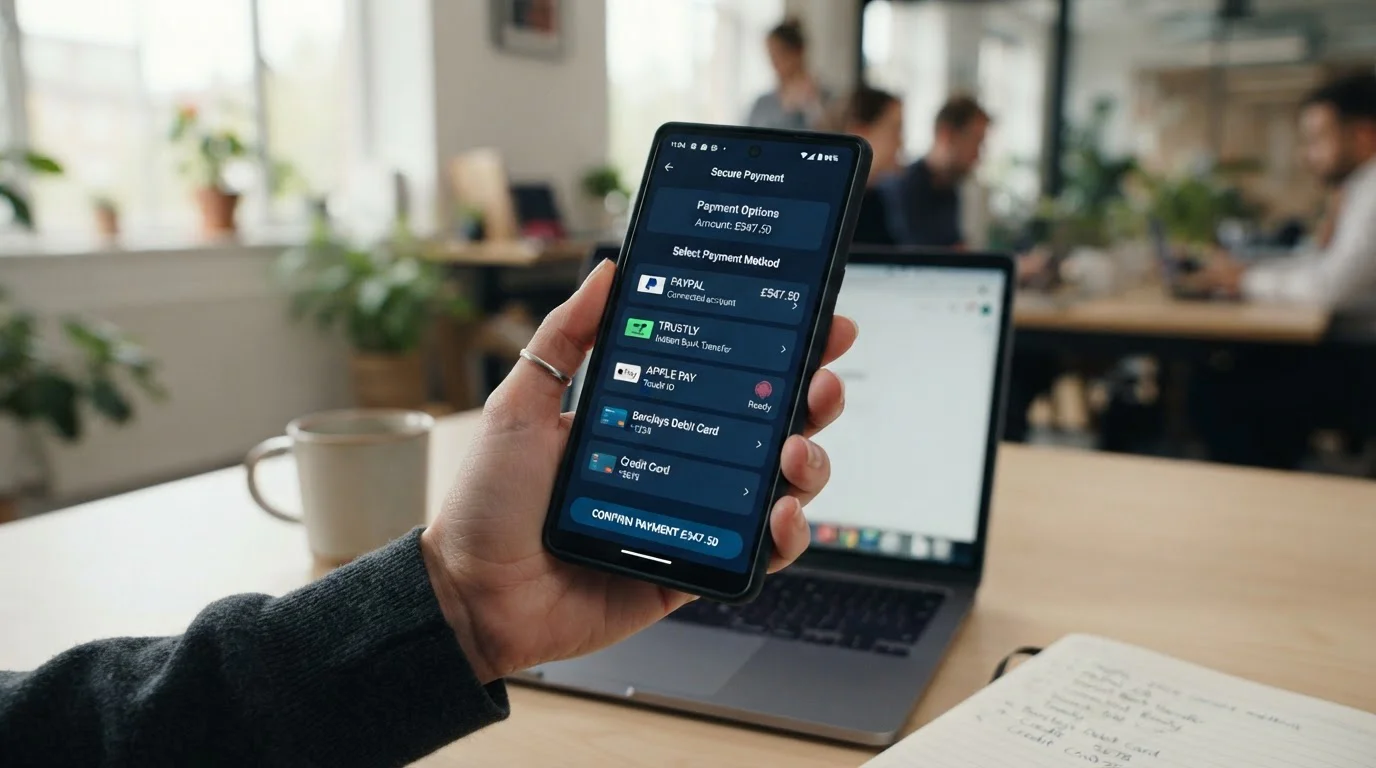
UK players need payment methods that clear in GBP, integrate with UK banks, and operate under FCA regulation. Four options dominate UKGC casino cashiers: PayPal, Trustly, Visa and Mastercard debit, and Apple Pay. Each works where Interac doesn’t, and most deliver faster withdrawals than Interac’s one-to-three-day Canadian standard.
| Method | Deposit Speed | Withdrawal Speed | Min Deposit | Acceptance | |—|—|—|—| | PayPal | Instant | 24 hours typical; 35 minutes tested at Casumo | £5–£10 | ~40 UKGC casinos | | Trustly (Pay N Play) | Instant | Instant at select operators; 50 minutes tested at Betway | £10–£20 | Growing adoption; Betway, Mr Green, Rizk | | Visa/Mastercard Debit | Instant | 1–5 days; Visa Fast Funds under 1 hour at select sites | £5–£10 | 100% of UKGC casinos | | Apple Pay | Instant | Rare (most deposit-only); withdrawals to original card when supported | £5–£10 | 30+ UKGC casinos |
What are the best alternatives to Interac for UK players?
PayPal, Trustly, Visa/Mastercard debit, and Apple Pay are the top UK alternatives. All work at UKGC-licensed casinos, process GBP natively, and deliver instant deposits. PayPal and Trustly offer the fastest withdrawals, often under 24 hours, beating Interac’s 1–3 day Canadian standard.
PayPal
PayPal operates in the UK as PayPal (Europe) S.à r.l. et Cie, S.C.A., a Luxembourg-based e-money institution authorised by the Financial Conduct Authority under reference number 226056. Around 40 UKGC-licensed casinos accept PayPal, including major brands like Casumo, Betway, 888 Casino, and LeoVegas. Minimum deposit requirements sit at £5 to £10 depending on the operator, and deposits post instantly.
Withdrawals are where PayPal outperforms Interac. The typical clearance window is 24 hours, but Casino.org UK testing recorded a 35-minute withdrawal at Casumo in 2026. That’s significantly faster than Interac’s one-to-three-day norm in Canada. PayPal’s buyer protection policies add a layer of dispute recourse, though those protections don’t always extend to gambling transactions depending on the nature of the dispute.
The main limitation is coverage. Not every UKGC casino accepts PayPal. Around 40 operators integrate it, a fraction of the total licensed market. High-traffic brands tend to support it, but smaller or newer casinos often don’t, citing PayPal’s fee structure or integration requirements. UK players who prefer PayPal can still choose from a decent pool of licensed operators, but they won’t have the universal acceptance that debit cards offer.
Setting up PayPal for casino deposits requires linking a UK bank account or debit card to the PayPal account. Once linked, the casino sees PayPal as the funding source, and the player’s bank details remain hidden from the operator. That privacy layer appeals to players uncomfortable sharing card numbers directly, though it adds a middleman to the transaction chain.

Trustly (Pay N Play)
Trustly is a Swedish Open Banking payment provider authorised by the FCA under reference number 930881. It plugs directly into the UK’s Open Banking infrastructure, allowing players to deposit via instant bank transfer without creating a separate Trustly account. The casino integration uses Trustly’s Pay N Play technology, which verifies identity and initiates the deposit in a single flow, often skipping traditional registration forms.
Deposits clear instantly. Minimum thresholds range from £10 to £20 depending on the casino. Withdrawals are faster than traditional bank transfers because Trustly uses the same Open Banking rails in reverse. Casino.org UK recorded a 50-minute withdrawal at Betway in 2026. Not every UKGC casino supports instant Trustly withdrawals — some still batch them as standard bank transfers — but operators that fully integrate Pay N Play deliver speed comparable to or better than PayPal.
Trustly’s appeal lies in the streamlined user experience. A player clicks "deposit," selects their bank from a list, logs into online banking through the Trustly interface, authorises the payment, and the casino credits the balance immediately. No separate account to manage, no card details to store. The same flow works for withdrawals at supported casinos, pushing funds back to the player’s bank account without the multi-day clearance window traditional bank transfers require.
The trade-off is acceptance. Trustly adoption is growing among UKGC casinos — brands like Betway, Mr Green, and Rizk prominently support it — but it’s not yet universal. Players at casinos without Trustly integration default back to card or e-wallet methods. For those whose preferred casino supports it, Trustly arguably offers the best balance of speed, security, and convenience among UK payment options.
Visa/Mastercard Debit
Debit cards are the universal fallback. Every UKGC-licensed casino accepts Visa and Mastercard debit, making them the most widely available deposit method for UK players. Credit cards were banned for UK gambling in April 2020 under UKGC Licence Condition 5.1, but debit cards remain unrestricted. Minimum deposits typically start at £5 to £10, and deposits post instantly.
Withdrawals take longer than PayPal or Trustly but still beat Interac’s Canadian standard. The typical clearance window is one to five business days. Visa Fast Funds, a technology that pushes withdrawals to the card in under an hour, is supported at select UKGC casinos, with Casino.org UK recording a one-hour Visa withdrawal at Casumo. Not all operators implement Fast Funds, so withdrawal speed varies by casino, but the baseline is faster than Interac.
The main advantage is simplicity. UK residents already carry a debit card issued by a UK bank, so no signup or account linking is required. The player enters card details at the casino cashier, the transaction clears through the card network, and the deposit appears in seconds. Withdrawals return to the same card, creating a closed loop that satisfies both anti-money-laundering requirements and player convenience.
Security concerns around entering card details online are mitigated by two-factor authentication via 3D Secure (branded as Verified by Visa or Mastercard SecureCode). The player confirms the transaction through their banking app or SMS code, reducing fraud risk. Card networks and issuing banks fall under FCA regulation, adding another layer of consumer protection.
The downside is visibility. Every deposit and withdrawal appears on the player’s bank statement, which may be an issue for players preferring discretion. E-wallets like PayPal or Skrill aggregate transactions under a single merchant name, whereas card transactions typically list the casino operator directly. That transparency is a feature for players tracking spending but a drawback for those seeking privacy.
Apple Pay
Apple Pay functions as a tokenised mobile wallet that links to an underlying Visa or Mastercard debit card. Only debit cards are allowed for UK gambling transactions, per the April 2020 credit card ban. Around 30 UKGC-licensed casinos accept Apple Pay as of 2026, including BoyleSports, William Hill, Betway, and 888 Casino. Deposits are instant, minimum thresholds sit at £5 to £10, and authentication happens via Face ID or Touch ID on the player’s iPhone, iPad, Apple Watch, or Mac.
The tokenisation layer hides the actual card number from the casino, replacing it with a device-specific token that can’t be reverse-engineered to extract card details. That makes Apple Pay marginally more secure than entering card details directly, though the practical risk difference is small given 3D Secure protections on standard card transactions. The real advantage is speed: biometric authentication is faster than typing a card number and navigating 3D Secure prompts.
Withdrawals are less common. Most UKGC casinos that accept Apple Pay for deposits route withdrawals back to the underlying debit card, not through the Apple Pay interface. That means the withdrawal lands in one to five days via standard card processing, not instantly. A few operators support Apple Pay withdrawals, but it’s not the norm. Players using Apple Pay primarily benefit from faster deposits, not faster cashouts.
Apple Pay adoption is growing but still trails behind universal debit card acceptance. Around 30 UKGC casinos support it as of 2026, enough to give iPhone users a meaningful pool of licensed operators, but not comprehensive. Android users face a similar situation with Google Pay, which some UKGC casinos support but less widely than Apple Pay. Debit cards remain the universal option; mobile wallets are the convenience upgrade for players whose preferred casino integrates them.
Deposit and Withdrawal Mechanics (If You Have a Canadian Bank Account)
Interac e-Transfer operates through Canadian online banking. The sender logs into their bank’s website or app, selects Interac e-Transfer, enters the casino’s designated email address (provided in the casino cashier), specifies the amount, and optionally sets a security question and answer. The bank processes the request, debits the sender’s account, and notifies the recipient by email. The casino checks its email, auto-deposits the transfer if the security question is bypassed via auto-deposit, or manually claims the funds by answering the security question.
Do I need a Canadian bank account to use Interac?
Yes. Interac e-Transfer operates exclusively within the Canadian interbank network. Only accounts at Canadian banks and credit unions participating in Interac can send or receive e-Transfers. UK banks do not connect to Interac, so UK residents cannot use the method unless they hold an active Canadian account.
Deposits at Interac-accepting casinos typically clear in five to 40 minutes, depending on the casino’s processing workflow and whether auto-deposit is enabled. Minimum deposits usually start at CAD 10. Most casinos don’t charge a fee on their end, but the sender’s bank may apply a per-transaction Interac e-Transfer fee, commonly CAD 1 to CAD 5, depending on the account type. Some Canadian banks offer unlimited free e-Transfers on premium accounts.
How long do Interac withdrawals take at online casinos?
Interac withdrawals at Canadian-facing offshore casinos typically take one to three business days after the casino approves the cashout request. The casino sends an Interac e-Transfer to the player’s registered email, and the player claims it by logging into their Canadian bank account and depositing the transfer.
Withdrawals reverse the flow. The player requests a withdrawal in the casino cashier, specifying Interac e-Transfer as the method. The casino processes the request, typically within 24 to 48 hours depending on its internal approval queue and KYC checks. Once approved, the casino initiates an Interac e-Transfer to the email address the player registered with. The player receives an email notification, clicks the link, logs into their Canadian bank account, and deposits the transfer. The funds land in the player’s account within minutes of completing that step, but the total elapsed time from withdrawal request to funds availability is one to three business days.
Are there any fees for using Interac at casinos?
Casinos rarely charge fees for Interac deposits or withdrawals, but the player’s Canadian bank may apply per-transaction Interac e-Transfer fees of CAD 1 to CAD 5, depending on the account type. Some banks offer unlimited free e-Transfers on premium accounts.
Daily and transaction limits apply on the banking side, not the casino side. Canadian banks typically cap individual Interac e-Transfers at CAD 3,000, though some institutions allow higher limits for verified accounts. Daily sending limits often sit around CAD 3,000 to CAD 5,000, and weekly or monthly caps may apply depending on the bank’s fraud-prevention policies. Players moving larger sums split them across multiple transfers or request alternative withdrawal methods like bank wire.
The Canadian expat edge case becomes relevant here. A UK resident who maintained a Canadian bank account from prior residency can technically fund an offshore casino via Interac, but several friction points arise. First, the bank may flag e-Transfers to gambling-related email addresses, particularly if the account shows little recent activity or the account holder’s registered address is outside Canada. Second, the casino’s KYC process requires proof of identity matching the bank account holder, and submitting UK-issued ID while funding with a Canadian bank account can trigger enhanced due diligence or account suspension.
Third, IP geolocation checks add complexity. Most offshore casinos log the player’s IP address and compare it to the country of the funding method. A UK IP paired with a Canadian payment method raises red flags for money laundering or account-sharing. Using a VPN to appear Canadian while actually residing in the UK violates most casinos’ terms of service and can result in frozen balances or forfeited winnings. The technical capability exists — the Canadian bank account works, the casino accepts Interac — but the practical risk of compliance issues makes it an uncomfortable fit.
For UK residents with no Canadian banking ties, the entire section is academic. Interac e-Transfer simply isn’t accessible. The search results that led them here implied otherwise, but the payment method’s structural limitations remain unchanged.
Can I use Interac if I’m a Canadian living in the UK?
Yes, if you maintain an active Canadian bank account. However, casinos may flag the mismatch between your UK IP address and Canadian payment method, triggering KYC reviews or requiring proof that you’re authorised to use that account. VPN use to mask your UK location often violates casino terms and can result in account suspension.
Interac at UK Casinos: What the Search Results Don’t Tell You
Thousands of UK residents search "Interac casinos UK" every month, most landing on affiliate content that lists Canadian-facing operators without clarifying the geographic mismatch. The pattern is predictable: an affiliate site targets UK searches, ranks for Interac-related terms, and makes money from clicks by promoting offshore casinos that accept Interac for Canadian players. The content is technically accurate — those casinos do accept Interac — but the implicit promise of accessibility to UK users is false.
The mismatch persists because UK search demand is monetisable and Canadian operators appear in international search results. Affiliates face no penalty for ranking Canadian casino content in the UK search results; Google’s algorithms see topical relevance and clicks, not payment-method feasibility by geography. The player clicks through, scrolls past reassuring language about "Interac casinos for UK players," registers at the promoted casino, and only discovers the method is unavailable when they reach the cashier.
Some affiliate sites disclose the limitation, often buried three paragraphs down or tucked into an FAQ. Others omit it entirely, letting the player figure it out on their own. The result is confusion, wasted registrations, and a fractured user experience that could have been avoided with an upfront explanation.
The search "Interac casinos UK" itself encodes the contradiction. Interac is Canadian infrastructure; UK is the target market. The phrase implies a product that doesn’t exist. A more accurate search term would be "Canadian casinos that accept Interac," but UK residents don’t know to search that way because they encountered Interac mentioned in UK-targeted casino content first. The feedback loop reinforces itself: affiliates target the mistaken UK demand, UK players search the wrong terms, and the cycle continues.
From a UKGC perspective, none of this is actionable. Offshore casinos aren’t under UK jurisdiction, and affiliate content isn’t regulated by the UKGC unless the affiliate is promoting unlicensed gambling to UK residents, which the casinos listed here aren’t — they’re licensed in Malta or Kahnawake, just not in the UK. The Advertising Standards Authority can intervene if affiliate content makes demonstrably false claims, but saying "this casino accepts Interac" isn’t false; the casino does accept Interac, just not from UK bank accounts. The omission of that detail is misleading but not illegal.
For mobile and game-type searches like "Interac slots UK" or "Interac live casinos UK," the situation is even more detached from reality. Interac is a payment method, not a game category. Slots and live casino games are the same whether funded by Interac, PayPal, or debit card. These long-tail search variations exist because players search them, not because they describe a distinct product. An "Interac slot" is just a slot at a casino that accepts Interac deposits — and since UK players can’t use Interac deposits, the entire premise collapses.
The "new Interac casinos UK" subset follows the same logic. New casinos launch regularly, some accepting Interac for Canadian players, but none accepting it for UK players because the infrastructure remains unavailable. Affiliates target the search, list the latest Canadian-facing launches, and the UK searcher lands on content describing operators they cannot fund with their UK bank account.
The feedback from players who hit this wall typically manifests as forum posts and Reddit threads: "Why don’t UK casinos accept Interac?" "I read Interac works at offshore casinos, but the method isn’t showing up for me." "Is Interac banned in the UK?" The answers vary in accuracy, but the underlying reality is consistent. Interac isn’t banned; it’s structurally incompatible. UK banks don’t offer it, UK payment regulations don’t require it, and UKGC casinos have no business reason to integrate a Canadian payment method unavailable to their UK customer base.
The clearest signal that Interac has no UK future is the absence of any UK expansion plan from Interac Corp itself. The company’s public communications, partnership announcements, and product roadmap focus on Canadian coverage and specific cross-border corridors like Interac e-Transfer to Mastercard Send. No UK integration has been announced, tested, or piloted. The UK payment landscape is mature, competitive, and well-served by existing rails. Interac would be entering a market that doesn’t need it, at significant cost, for uncertain return.
So when a UK player encounters "Interac casinos UK" in search results, what they’re seeing is the product of search targeting and affiliate revenue optimisation, not a description of a usable service. The casinos exist, Interac works, but the intersection of those two facts doesn’t extend to UK players with UK bank accounts. The search results don’t tell them that upfront. This page does.
Bonuses and Promotions at Offshore Interac Casinos
Offshore casinos that accept Interac structure their welcome bonuses similarly to UKGC operators but with looser wagering requirements in some cases and tighter cashout caps in others. Jackpot City offers CAD 1,600 spread over four deposits, Spin Casino offers CAD 1,000, and Ruby Fortune offers CAD 750. All three use tiered match structures: a percentage match on the first deposit (often 100 percent), a smaller match on the second deposit, and so on. Wagering requirements range from 50x to 70x the bonus amount, with maximum bet rules capping individual wagers at CAD 5 during bonus play.
The catch, common across offshore operators, is the first-deposit cashout cap. Jackpot City limits cashouts from the first deposit bonus to six times the deposit amount, meaning a player who deposits CAD 100, receives a CAD 100 bonus, and wins CAD 2,000 can only withdraw CAD 600. The rest is forfeited. That cap doesn’t appear in the headline bonus figure, and players who don’t read the full terms often discover it only when attempting their first withdrawal.
Free spins frequently accompany deposit bonuses, ranging from 50 to 200 spins depending on the promotion. The spins are typically restricted to specific slots, often titles from Microgaming or NetEnt, and any winnings from free spins carry their own wagering requirements separate from the deposit-bonus terms. Spin values are usually fixed at CAD 0.10 or CAD 0.20 per spin, so 100 free spins translates to CAD 10 or CAD 20 in spin value, not CAD 100 or CAD 200.
Ongoing promotions at Interac-accepting offshore casinos include reload bonuses on subsequent deposits, loyalty-point schemes, and VIP tiers with escalating perks. Ruby Fortune’s Casino Rewards integration allows players to earn points across multiple casinos in the same network, redeeming them for bonuses or merchandise. Jackpot City and Spin Casino run standalone loyalty programs, with points earned per CAD wagered and tier progression unlocking faster withdrawals, higher deposit limits, and dedicated account managers.
For UK players, these bonuses are irrelevant unless they hold a Canadian bank account and navigate the verification friction described earlier. The promotions target Canadian players with CAD accounts and Interac deposits. A UK player who registers at one of these casinos without Interac capability will see the same bonus offers but must fund their account via an alternative method — usually Visa, Mastercard, or an e-wallet like Skrill — which the offshore casino accepts internationally. The bonus itself doesn’t care about payment method; the problem is reaching the point of funding the account in the first place.
Bonus abuse protections at offshore casinos are less sophisticated than at UKGC operators but still present. Multi-accounting is prohibited, and operators use IP tracking, device fingerprinting, and payment-method matching to detect duplicate accounts. Players caught with multiple accounts forfeit bonuses and sometimes balances. The enforcement is spottier than at UKGC casinos, but the risk exists.
The value proposition of offshore bonuses compared to UKGC alternatives is mixed. UKGC casinos introduced a 10x maximum wagering requirement cap in January 2026, meaning no UKGC bonus can require more than 10x playthrough on the bonus amount. Offshore operators remain uncapped, with requirements ranging from 30x to 70x. That makes UKGC bonuses easier to clear but often smaller in headline value. Offshore operators can afford larger nominal bonuses because the high wagering and cashout caps mean most players never extract full value.
For UK players weighing offshore bonuses, the calculation should account for the lack of UKGC protections, higher wagering requirements, and the cashout caps that limit upside. A CAD 1,600 bonus at 70x wagering with a 6x first-deposit cashout cap is less valuable than it appears at headline. A £100 bonus at a UKGC casino with 10x wagering and no cashout cap delivers more extractable value despite the smaller number.
The bottom line for UK players: offshore Interac casinos run competitive promotions for their target Canadian audience, but those promotions offer no unique advantage to UK residents who can’t fund accounts via Interac and lose UKGC consumer protections in the process. The "bigger" offshore bonuses come with structural disadvantages that erase most of their nominal edge.
Created by the ”Payments-casino-uk” editorial team.